
North American Wrap-Up
- Monday, November 10, 2003
This analysis featured in the November 10, 2003 issue of the HGCA's MI Prospect, Volume 6, Number 10
Key points
- North American grain supplies up but still modest
- Soya beans hit by late hot dry conditions
- Record US maize crop
- But year end stock still not expected burdensome
- Early signs weather still key for 2004
Very favourable North American spring conditions for crop development promised excellent harvests. But the weather turned hot and dry in late July and August. Most crops were close enough to maturity or in good enough condition to avoid serious damage. Soyabeans were an important exception. Total supplies of North American grain and oilseeds, while higher than a year ago, are not large in a longer term perspective.
Wheat
The overall yield for all classes of winter and spring wheat was a record 2.97 tonnes per hectare. The harvested area of 21.4M hectares was, however, by US standards relatively modest. Total production of 63.6M tonnes was, although 44 percent above the 2002 drought reduced level, well below the 75M tonne crops achieved in the past and harvested off more than 30M hectares.
As the carryover from last year was minimal, US supplies of 79M tonnes are not large by past standards (graph 1). This is, last year excepted, the smallest US supply since 1996/97. The USDA is currently projecting a 23 percent increase in exports and a 28 percent increase in year end closing stocks. While both increases seem large, 2002 supplies were severely limited by the drought.
continue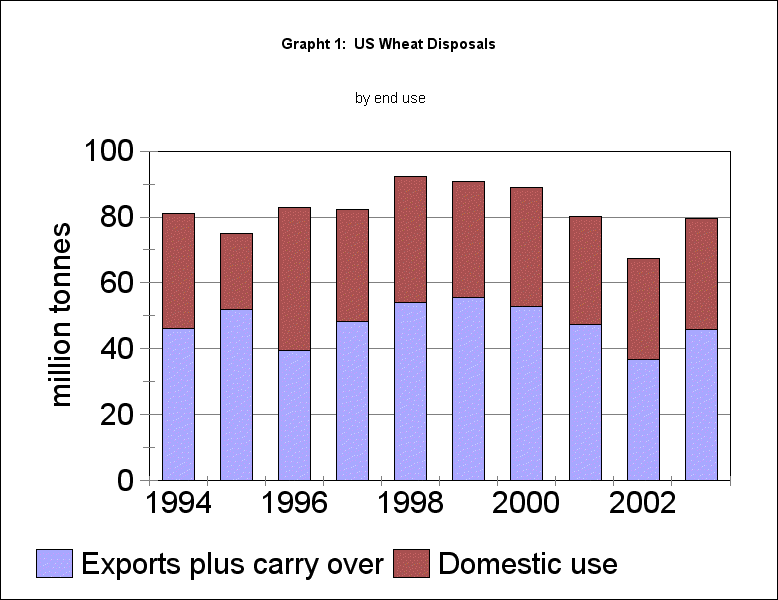
Source: HGCA/DEFRA
continued
US export inspections after almost five months of the current US crop year are 11.7M tonnes, 24 percent above year ago levels. Outstanding sales of 4.1M tonnes are 14 percent below year ago levels. Total commitments are reported at 15.7M tonnes, 11 percent above year ago levels.
The wheat situation in Canada is somewhat similar. Statistics Canada's September production estimates generally confirmed that the impact of hot and dry conditions during late July and August were not as serious as earlier anticipated. Production of wheat other than durum was estimated to be just under 18M tonnes, 46 percent above last year's drought reduced level. It is, however, a modest crop by past standards. It is seven percent below a ten-year average, due to a small area rather than low yields.
With a minimum carryover and a mediocre crop Canadian wheat supplies are, last year aside, the lowest in ten years (graph 2). Agriculture Canada is forecasting exports of 11.2M tonnes compared to the typical range of 13M to 16M tonnes, with no appreciable increase in closing stocks.
continue
Source: HGCA/DEFRA
continued
The Canadian durum supply situation also remains relatively tight. While durum escaped the worst of the 2002 drought, it was more severely affected by the drought this year. Durum exports are projected at 3.4M tonnes compared to a typical range of 3.8M to 4.2M tonnes.
Coarse Grains
In October the USDA forecast US maize production at 259M tonnes. This is equivalent to 10.2 billion bushels, and the first US crop above the 10 billion bushel level. Both the yield and the size of the harvest would be records, if achieved. The crop developed under very favourable conditions until after pollination, and subsequent hot and dry conditions do not appear to have had a serious impact on yield.
More critical than the size of the US crop, however, is the level of anticipated US consumption, currently projected at 207 M tonnes. Generally favourable livestock prices and margins for industrial processing of maize have resulted in sustained growth in consumption in recent years.
The USDA is currently forecasting exports of 51.1M tonnes, of which 45.7M are maize, and just a modest increase in closing stocks. Even though supplies of US corn this year are above average, supplies surplus to projected domestic needs are not (graph 3).
continue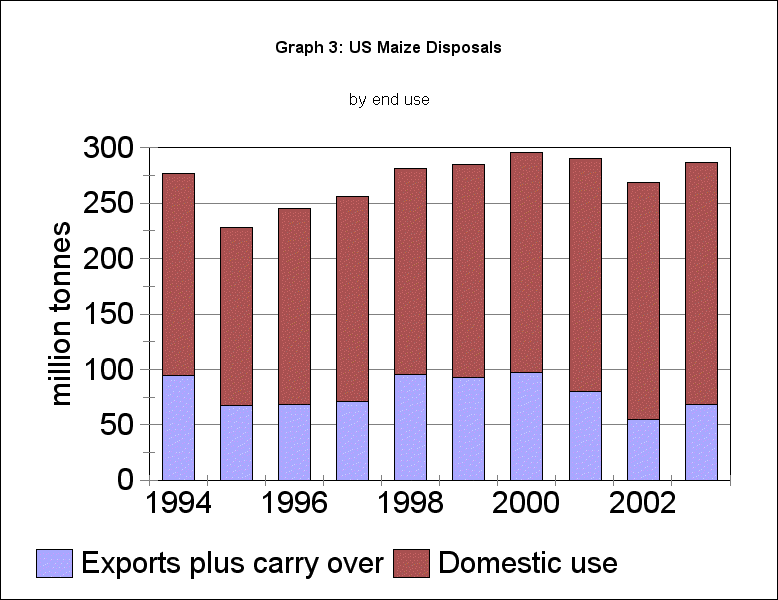
Source: HGCA/DEFRA
continued
US maize prices declined by 10 percent during the early summer when crop prospect were excellent, recouped their loss during the heat wave in August, lost a similar amount when it became apparent yields had not been affected, and have recently regained the losses again probably on the realization that domestic and offshore demand is robust. This extreme volatility is indicative of a relatively tight world feed grain situation.
Canadian barley production is currently estimated to be 12.2M tonnes, 63 percent above last years drought reduced level. A 34 percent increase in harvested area and a 24 percent increase in yields contributed. This is towards the low end of a typical range for Canadian barley production. And with a very low opening stock, total Canadian supplies are still well below normal.
The crop was, however, generally harvested in good condition. All important to malting markets, germination is unlikely to be a challenge, although protein content may be higher than maltsters would like. Further feed consumption is likely to be restrained as long as the US border remains closed to Canadian slaughter cattle following a single case of BSE last January. Canadian exports of malting barley will almost certainly recover from last year's drought reduced level.
Soybeans
The US soyabean harvest has been seriously affected by the hot and dry conditions in the Corn Belt and northern Great Plains in August, when the crop was in the critical podding stage. The USDA has progressively reduced expected yields in a succession of crop projections as damage to the crop has become apparent. In October it projected total production at 67.2M tonnes, 10 percent below 2002 output and the smallest crop since 1996.
With a modest opening stock, US supplies of soyabeans are the lowest since 1996 (graph 4). Soyabean prices have risen by about 60 percent since mid-August to ration these limited supplies.
continue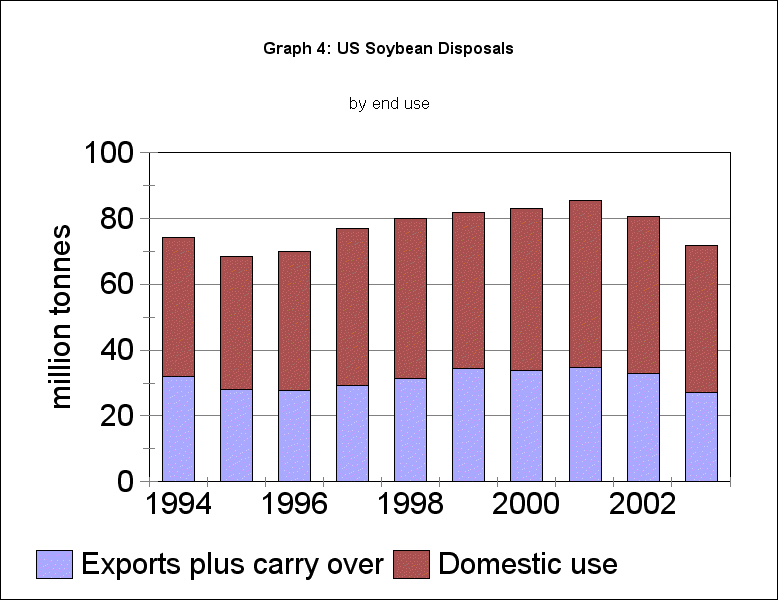
Source: HGCA/DEFRA
continued
2004 Prospects
Early USDA reports of winter wheat conditions indicate the 2004 crop is in 49 percent good or excellent condition. This compares to 58 percent for the 2003 crop, which ended up being a good one, and 46 percent for the 2002 crop which ended up being a poor one. It is, however, too early to make judgement on prospects on the crop which is only 80 percent emerged.
In western Canada concerns over surface and sub soil moisture continue to mount. The excellent moisture of early summer was depleted by crop development during July and August. Further, generally dry conditions since, beneficial for harvesting, have done little to replenish moisture deficits. It seems increasingly evident that the 2004 crop will, like the 2003 crop, be very dependent on both at least average and timely rain next spring and early summer.
David Walker
phone: 01603 705153
top of page